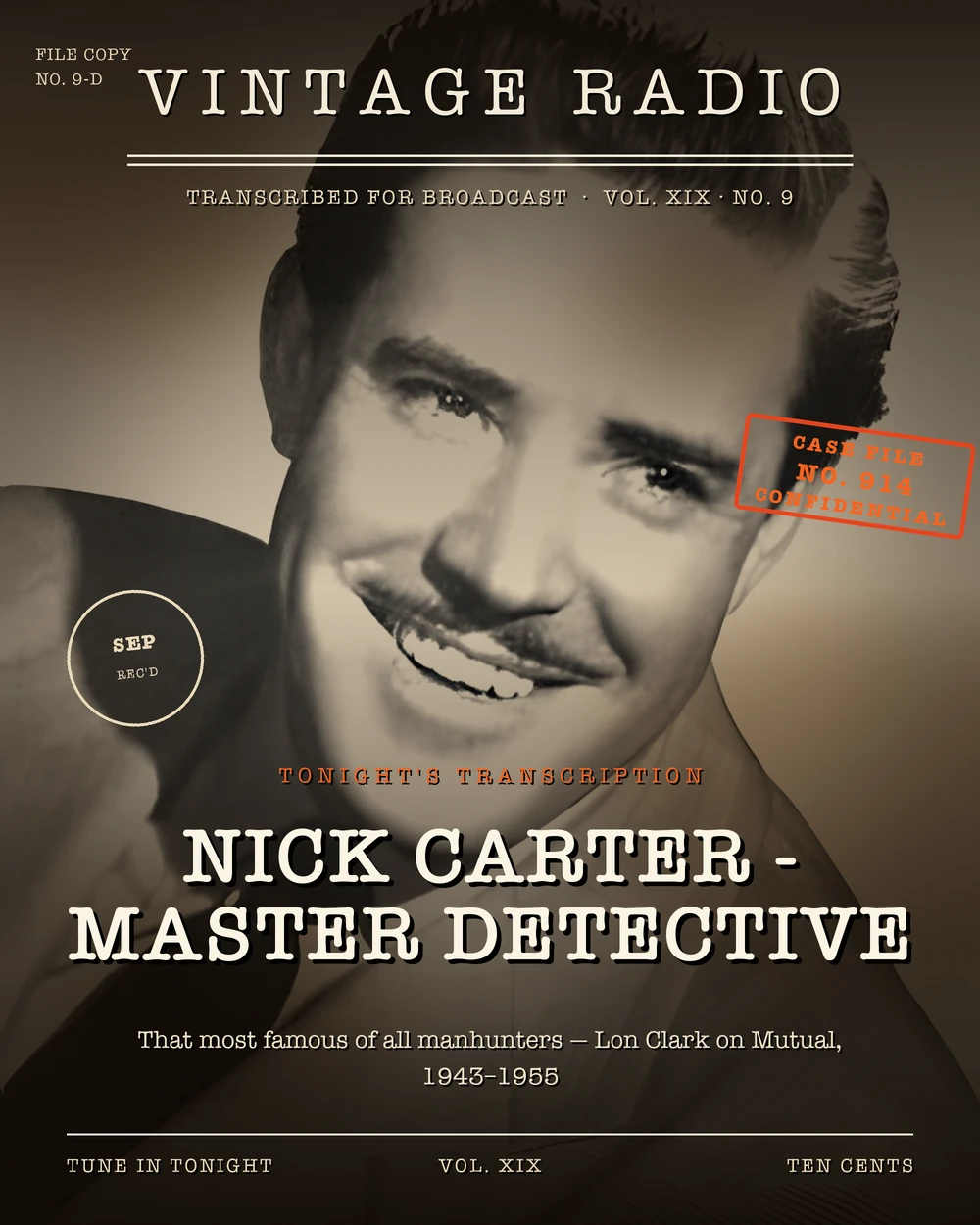
Nick Carter - Master Detective
A Detective Older Than Sherlock Holmes
Nick Carter had already been solving crimes for fifty-seven years by the time he arrived on Mutual Radio in 1943. His first story appeared in Street & Smith's New York Weekly on September 18, 1886 — a 13-week serial called "The Old Detective's Pupil; or, The Mysterious Crime of Madison Square." That debut came roughly a year before Arthur Conan Doyle introduced Sherlock Holmes to the world, a fact that prompted pulp historian Jess Nevins to label Carter "the grandfather of superheroes." The character was conceived by Ormond G. Smith, son of one of Street & Smith's founders, and fleshed out by writer John R. Coryell. Frederick Van Rensselaer Dey took over the writing chores around 1891 and kept going — eventually producing 1,076 novels and stories under the Carter name.
By the time the radio show launched, the character had lived through dime novels, a dedicated weekly serial, Detective Story Magazine, a 1930s pulp revival, appearances in Shadow Comics, and three MGM films starring Walter Pidgeon. The radio title — at first The Return of Nick Carter, an explicit nod to those 1886 origins — made clear that everyone involved knew exactly what kind of legacy they were working with.
One detail the dime novels established that the radio show quietly revised: in print, Carter's assistant "Patsy" was a male shoe-shine boy named Patsy Walker. The radio version transformed the character into Patsy Bowen, a female secretary — a change one radio commentator described as "a sort of literary sex-change." The dime-novel Nick Carter was also a physically specific character, described as 5'4" with bronze skin, gray eyes, dark hair, and a square jaw — known by the nickname "The Little Giant." The radio show kept the name and the detective tradition and let the rest quietly evolve.
How the Show Worked
The opening sound sequence was immediately recognizable. A visitor approached the door to Carter's brownstone office and knocked — once, then louder, then harder still, the urgency escalating with each round. Patsy would jerk the door open with a startled cry: "What's the matter, what is it?" The announcer then introduced Nick as "that most famous of all manhunters, the detective whose ability at solving crime is unequaled in detective fiction." Individual episode titles were read by a graveled voice just above a whisper, and episodes often carried two titles — one for the story, one as an alternate billing. An episode called Death in the Pines, for instance, might also be billed as The Mystery of the Murdered Driver.
The format followed what you might call the classic reveal structure: Nick gathered clues across the episode, and no one — including the listener — knew who had committed the crime until the very end. Each episode closed with an epilogue in which Nick walked through every clue and explained what it meant and how it had sealed the killer's fate. It was a deliberate structural choice, and it gave the show a puzzle-like quality that rewarded close listening.
The recurring cast gave the show a comfortable, lived-in feel. Sgt. Mathison — known as "Matty" — of the police department was played by Ed Latimer, and the character had a running joke built into him: Mathison took constant offense at any suggestion that his success in homicide owed anything to his friendship with Nick Carter, while Patsy would cheerfully remind him otherwise. John Kane played Scubby Wilson, the "demon reporter" and friend to both Nick and Patsy. The supporting cast was drawn from New York radio actors, including Bill Johnstone, Bryna Raeburn, Raymond Edward Johnson, Maurice Tarplin, and Al Hodge. Michael Fitzmaurice served as announcer. Organ music came from a rotation of players — Lew White, George Wright, and Hank Sylvem. Jock MacGregor produced and directed throughout the run. In a 1946 episode, Nick mentions that at least one insurance company keeps him on retainer — one of the rare moments the show acknowledged how its hero actually paid the rent.
Lon Clark and the Cast
Lon Clark played Nick Carter for the entire run — twelve years, across several hundred episodes — and his rich baritone was central to the show's identity. He was born January 12, 1912, in Frost, Minnesota, a small town his grandfather had helped found after immigrating from Norway. His interest in acting started young, in part because his mother played piano for silent films and he got free admission to the theater. As a youth he studied at the MacPhail Center for Music in Minneapolis, then performed in traveling tent shows and spent a season with the Cincinnati Summer Opera.
Clark worked at radio station WLW in Cincinnati from 1936 to 1940, also serving as a baritone soloist at First Presbyterian Church in Walnut Hills. He relocated to New York City in 1941, and his voice got him steady network work quickly — including the district attorney in Front Page Farrell and roles in Words at War and Soldiers of the Press. During the same years he played Nick Carter, he appeared opposite Fred Allen, Art Carney, Helen Hayes, and Orson Welles in various productions. In 1956, he replaced Jason Robards in the role of Jamie — James Tyrone, Jr. — in the original Broadway run of Eugene O'Neill's Long Day's Journey Into Night. Late in his career he appeared in four episodes of CBS Radio Mystery Theatre. He remained married to Michelle Trudeau Clark until his death on October 2, 1998, in New York City.
Helen Choate played Patsy Bowen through mid-1946, when Charlotte Manson took over the role and held it for the remainder of the run.
The Writers Behind the Scripts
The writing staff included some notable names. Ferrin Fraser, a veteran radio dramatist, contributed many scripts. David Kogan, Milton J. Kramer, John McGreevey, and Norman Daniels also received credits over the course of the run.
Walter B. Gibson joined the show as head writer after being fired from Street & Smith in 1946 — he had asked for a raise. Gibson had previously written at least 283 of the 336 Shadow pulp novels under the pseudonym Maxwell Grant, so he knew his way around a crime-fiction plot. He notably had no interest in writing for the radio version of The Shadow, despite both properties sharing the same Street & Smith parentage. Producer-director Jock MacGregor picked him up almost immediately after the Street & Smith departure.
Alfred Bester also wrote scripts for the show during this period, alongside work for The Shadow, Charlie Chan, and Nero Wolfe. Bester went on to win the inaugural Hugo Award in 1953 for his science fiction novel The Demolished Man and was later named an SFWA Grand Master posthumously in 1988. His radio work, including his Nick Carter scripts, came in the years before his science fiction career took hold.
Sponsors, Timeslots, and the Long Sunday Run
The show's early years were restless. Between 1943 and 1946, it bounced through eleven different timeslots — running as a 15-minute serial four or five times a week for a stretch in 1944, then as a 30-minute Sunday program at 3 p.m. under Acme Paints and Lin-X, then shifting to Tuesday evenings. For much of this period it was sustained, meaning it had no sponsor and the network covered the costs.
The Old Dutch Cleanser sponsorship, which began in August 1946, brought stability. The sponsor intro that came with it leaned into the obvious parallel: "Old Dutch Cleanser famous for chasing dirt presents… Nick Carter, famous for chasing crime." Cudahy Packing, maker of Del Rich Margarine, co-sponsored during the same stretch. That arrangement held from August 18, 1946 through September 21, 1952 — a Sunday 6:30 p.m. slot that gave the show its longest continuous run. Libby Packing came on as sponsor from 1952 to 1953, and the final two years ran at 4:30 on Sundays until the show ended September 25, 1955. Acme Products, the earlier sponsor, made Kem-Tone paints and Lin-X floor-cleaning waxes — positioned explicitly as competition to Johnson's Wax, which sponsored numerous NBC programs. The show's sponsor story is almost a map of mid-century American consumer products.
The Spinoff and the Larger Nick Carter World
In July 1943, just a couple of months after Nick Carter - Master Detective launched, Mutual added a companion series: Chick Carter, Boy Detective. It ran Monday through Friday at 3:00–3:15 p.m. as a 15-minute serial aimed at younger listeners, featuring the adopted son of Nick Carter in cliffhanger-format adventures. Bill Lipton played Chick through July 3, 1944; Leon Janney took over and held the role through the series' end on July 6, 1945, and later became a regular member of the CBS Radio Mystery Theatre cast. Officials at WOR, Mutual's flagship New York station, described the pairing as "the first related pair of adult and juvenile series in radio." In 1944, production briefly attempted to weave the two storylines together during the period when Nick's show was in its own 15-minute serial format.
The Nick Carter character continued in other media well beyond radio. MGM had produced three films starring Walter Pidgeon as Nick, with Donald Meek as his comic sidekick Bartholomew — Nick Carter, Master Detective in 1939, directed by Jacques Tourneur, followed by Phantom Raiders and Sky Murder in 1940. The 1939 film ran 59 minutes and, according to studio records, lost $93,000 after earning $276,000 domestically and $180,000 internationally. New York Times reviewer Frank S. Nugent wrote: "No, this isn't Nick Carter as we remember him, but it's an amusing fiction for all that." Tourneur went on to direct Cat People and Out of the Past, but the Nick Carter pictures were among his first feature-length assignments. A 1972 made-for-television film, The Adventures of Nick Carter, starred Robert Conrad as Nick alongside Shelley Winters and Broderick Crawford; it was intended as a series pilot but did not advance. And in 1964, the character was reinvented entirely as a globetrotting spy called "The Killmaster" in a paperback series inspired by the James Bond phenomenon — 261 Nick Carter: Killmaster novels appeared between 1964 and 1990.
Radio Spirits estimated that nearly 700 broadcasts of Nick Carter - Master Detective aired between 1943 and 1955; the Thrilling Detective Web Site puts the count at 722 episodes. The episode set was certified complete in a 2017 release — though the 96 episodes in known circulation represent only a fraction of the full run. A 6-episode serial arc titled "Accidental Bullet" from June 1944 survives, one of the few remnants from the early serialized period. Among the documented surviving episodes are "The Case of the Brick Oven Corpse" from July 3, 1949, and "The Case of the Impossible Murder" from April 5, 1953.